

Predictive analytics is an indispensable tool for businesses, empowering them to anticipate future outcomes.
This method combines multiple elements to analyze past data and predict future occurrences. By accurately understanding patterns it enables more knowledgeable, adaptable, and precise decision-making.
This article explores predictive analytics, detailing its functionality and emphasizing its significance as a crucial instrument for fostering strategic business expansion.
What is predictive analytics?

Predictive analytics leverages statistics, algorithms, and machine learning to analyze data. Its primary function is to forecast future events by identifying patterns in historical trends.
This capability empowers organizations to pinpoint potential risks and opportunities, thus enabling well-informed decisions that optimize outcomes and stimulate growth.
How does predictive analytics work?

Predictive analytics may seem complex, but its implementation in your company is a straightforward, step-by-step process, as outlined below:
1. Data collection and preparation
First, gather the necessary data to train the model. This includes historical records, customer behaviors, demographics, and metrics.
The quality of this data and its integration from various sources are vital. Incorporate information from CRM and ERP systems, social media, IoT sensors, and internal databases.
After collection, clean the data by removing duplicates, correcting errors, and filling in missing values.
This step is crucial, as the accuracy of the analysis directly depends on the quality of the information.
2. Model selection and training
After preparing the data, the next step involves choosing the most suitable model for the desired predictions. A range of approaches exists, from traditional models to machine learning algorithms.
The selection hinges on factors such as data volume, the type of variable to be predicted, and the required level of prediction accuracy.
Once the model is selected, the training phase begins. This involves feeding data into the algorithm, allowing it to identify patterns and relationships between variables. Through this learning process, the model gains the ability to generalize its understanding and predict future behaviors in comparable scenarios.
3. Validation and evaluation of the model
After training, validating the model's accuracy with both existing and new data is crucial.
This process, known as cross-validation, assesses the model's predictive power and prevents overfitting.
Overfitting happens when a model memorizes training data but fails to adapt to new situations. For successful validation, a proper balance between model complexity and accuracy is essential.
4. Application of the model
Once validated, the model can be applied to various datasets, generating predictions that aid in decision-making.
For instance, it can identify customers likely to cancel a service or products expected to be in high demand in the upcoming months.
This implementation can be achieved via analytical platforms, integrations with internal company systems, or other methods. In large corporations, predictive analytics can even directly connect to automation systems to execute actions, such as triggering alerts, without human intervention.
5. Interpretation and action
While predictions are vital, their true value lies in interpretation and action. This stage converts model outputs into actionable insights for decision-making.
For instance, if a model identifies customers at risk of churning, targeted retention campaigns can be launched. It's crucial to remember that these actions need continuous monitoring, as predictive analytics is neither flawless nor static.
Regular reviews, adjustments, and retraining are essential to maintain data accuracy and relevance, even as contexts change.
What types of predictive models are there?

Predictive analytics can yield results through several key models, which include:
1. Classification models
These models are employed for predicting categories or labels, as opposed to numerical values.
The model classifies specific data within a group by identifying patterns during training with pre-categorized data. The most common algorithms for this task include:
Logistic regression
This predictive analytical method determines probabilities rather than numerical values, which are then categorized. It is particularly effective when there are only two potential outcomes, such as "yes" or "no," or "purchase" or "no purchase."
For instance, it can effectively predict whether a customer will cancel a service, using their usage history as a basis.
Random forests
This method utilizes multiple decision trees working in conjunction. Each tree provides an individual prediction, and the system selects the most frequent decision.
This approach minimizes errors, enhances result accuracy, and is especially effective for classifying intricate data and preventing overfitting.
Support vector machines
This predictive analytics model categorizes data within a given space, aiming to maximize the separation between groups.
It is particularly effective when differentiating complex data.
2. Regression models
These systems are designed to predict a continuous numerical value. For example, they can be used to estimate the price of a house based on its characteristics (such as location and size) or to forecast future income, among other applications.
3. Clustering models
While not a predictive analytics model in the traditional sense, this approach is valuable for initial segmentation and pattern discovery.
Models like k-means group data based on similarities without needing prior labels. This allows for identifying customer types with similar behaviors, enabling the design of personalized strategies for each group.
This method is particularly useful when a clear target variable is absent, but the goal is to understand the data's underlying structure.
4. Time series models
Focusing on dynamic data, this approach analyzes historical trends to predict future values.
This is crucial for strategic planning and decision-making over the medium and long term, with sales forecasting and online traffic estimation being prime examples.
Which model should you use depending on the objective?
To determine the most suitable model for your organization, refer to the table below for detailed insights.
|
Business objective |
Recommended model type |
Type of prediction |
|
Predict customer churn |
Ranking |
Category (Yes/No) |
|
Calculate monthly income |
Regression |
Numerical value |
|
Group customers by behavior |
Clustering |
Segmentation |
|
Estimate product demand in a given month |
Series temporales |
Value by date |
What benefits does predictive analytics offer?

Predictive analytics empowers businesses to achieve intelligent and sustainable growth.
Key benefits include:
Improved decision-making
Predictive analytics allows companies to move beyond intuition in decision-making.
By analyzing vast amounts of historical data and identifying patterns, businesses can foresee behaviors, market demands, or potential issues before they arise.
This leads to a more precise and realistic understanding of the current situation, enabling the development of strategies that are more closely aligned with the company's specific requirements.
Risk reduction
Predictive analytics plays a crucial role in loss prevention. It utilizes models to identify unusual patterns or warning signs, allowing for the proactive anticipation of issues such as fraud, customer churn, or critical technical failures.
This proactive approach enables early intervention, preventing costly errors and problems.
Process optimization
Predictive analytics helps companies optimize workflows, automate tasks, and reduce costs more efficiently by identifying areas of opportunity or bottlenecks in internal processes.
For instance, it can detect stages of production with high waste rates, enabling the implementation of corrective actions to reduce them.
Personalization of the customer experience
Enhanced customer insight allows businesses to identify customer needs and address them effectively at the opportune moment and via the appropriate channel.
Predictive analytics facilitates the study of consumer behavior, enabling the anticipation of their product interests and the optimal time for engagement.
This, in turn, streamlines campaign personalization, product adaptation, and the delivery of a more gratifying customer experience.
Development of new products and services
Optimizing existing processes fosters innovation, enabling companies to launch solutions ahead of competitors.
The capacity to predict trends, market shifts, and unaddressed demands is vital.
This approach also mitigates the risk of launching superfluous products, thereby conserving both time and financial resources.
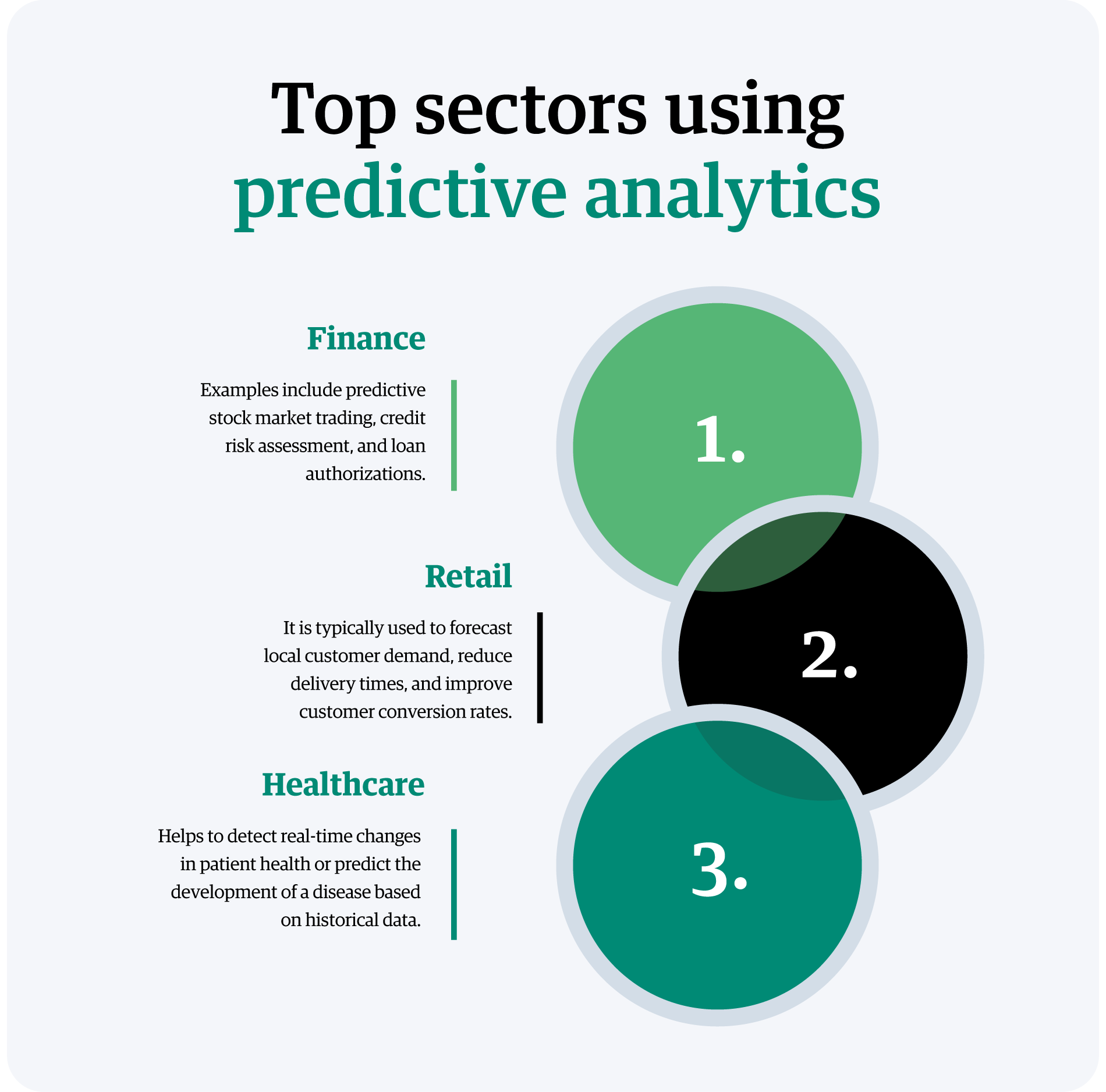
What are the use cases for predictive analytics?
Organizations are increasingly using predictive analytics to optimize both short-term and long-term decision-making.
Its main applications are detailed below.
Unlock the power of predictive analytics and make smarter decisions

Predictive analytics is a vital strategic tool for companies, offering the ability to anticipate events, enabling proactive measures and significantly reducing uncertainty.
For organizations aiming for more agile, strategic, and evidence-based decision-making, integrating predictive analytics is an opportune move. It's crucial to understand that this approach doesn't predict the future, but rather actively shapes it through data and intelligence.
If you require support for this transformation, London Consulting Group can provide guidance and the necessary tools.